
Warfare Not Welfare

Serious people are telling us that the United Kingdom needs to spend more on defence. Successive governments, they say, have neglected the security of the country by spending too little on the armed forces. Britain has relied on allies building up their strength while diminishing our own. They call for cutting a bloated welfare budget to fund the weapons capability required to keep us safe.
None of this is true.
After the fall of the Soviet Union most countries in Europe took advantage of the peace dividend to reduce the resources directed towards defence. However before long NATO sought to put a floor under the level of military expenditure. In 2006 the organisation adopted a guideline for member states to spend at least 2% of their GDP on defence. Few countries met the benchmark and so the guideline was upgraded to a formal target in 2014.
The UK was one of the few members of NATO which consistently met the target. Germany was a notable laggard but France too fell short.
In recent years NATO has set higher targets, however the latest figures still show that the UK commits more of its budget to defence than most European countries including France, Germany, Spain and Italy.1
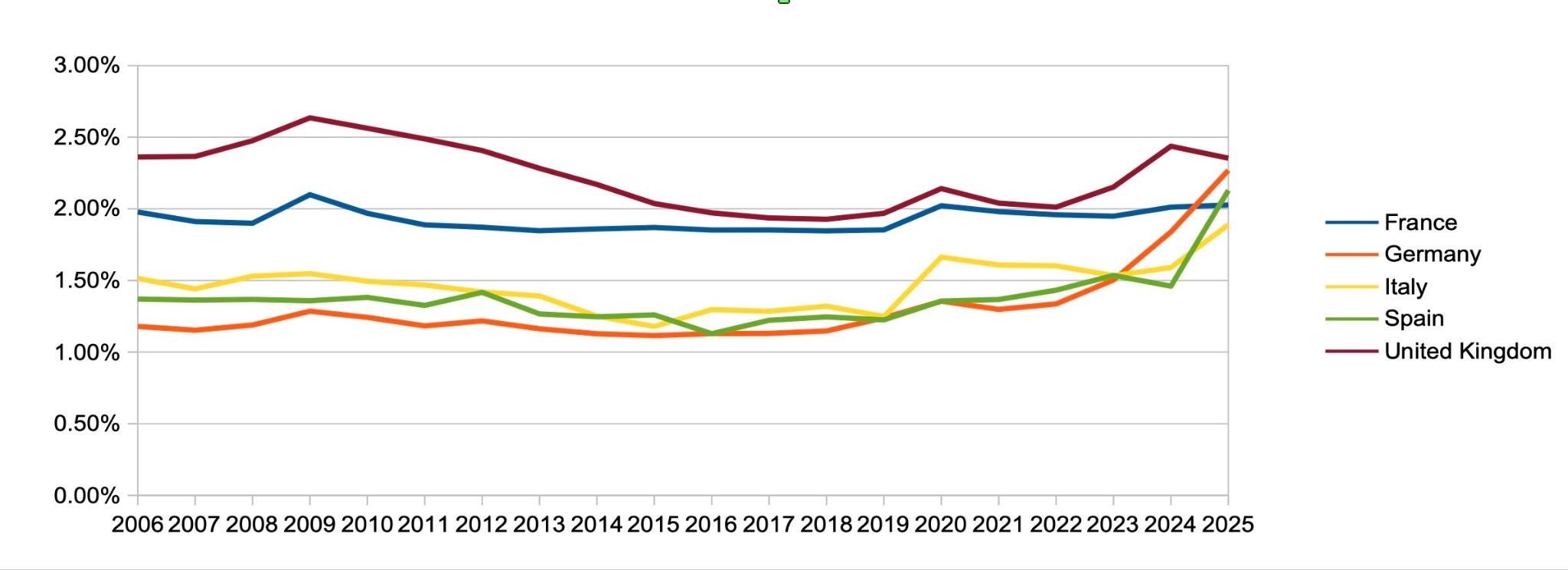
So it is false to claim that British governments have neglected defence spending. It is false to say that other allies have been carrying the burden of collective security. It is false to suggest that Britain is falling behind as others expand their budgets.
It is equally false to claim that welfare spending is booming or out of control. The resolution foundation recently examined the question and concluded that welfare spending is stable. At 10.8% of GDP the welfare budget is 1.2 percentage points below its post recession peak in 2012-13.2
We are left with a question. If the country has been one of the higher spending NATO members, why are we now so ill prepared?
The most likely reason is that all that money was not spent well. Some of us have been critical of defence policy for a while. Defence budgets have not been used effectively both because of poor management of expensive programmes and by directing spending to the wrong priorities. There is quite a list of military projects with cost overruns and failures to deliver the promised capability. I would argue that large aircraft carriers and the supposedly independent deterrent are not what the country needs for security. The first is a tool of power projection which has little to do with defending the country. The second is tied to the US, an increasingly unreliable ally. Both have more to do with prestige than genuine security and both absorb resources that would provide a defence posture more in keeping with recent experience of modern warfare.
The security environment has changed since the Russian invasion of Ukraine and the change in US commitment to European security. The Ukraine war, like the wars in the Middle East, have shown that aggression rarely succeeds. Far from overwhelming its neighbour, Russia has exposed its weakness. Its actions in Ukraine are devastating and visit all the horrors of war on its people but military success is as far from being achieved as ever.
The lessons from Ukraine’s resistance are many with innovation and industrial organisation at the top of the list. So yes, there is a case for more resources to defence but not without first ensuring effective use of existing military spending. We should abandon the prestige projects, tie any increase in budget to new value for money controls, and focus on the industrial capacity for a more nimble, flexible approach to supplying the capability that can provide the security for the future.
https://www.resolutionfoundation.org/comment/is-welfare-spending-out-of-control/
Generals fight the last War. It's been obvious for years UK needs a massive mid-tech investment in drones. Massive ships are v expensive to run, and ultra-high tech toys for the boys is where UK dosh has gone given historic importance of our navy. We keep having Defence Reviews as a means of deferring decisions. That said, we are equally useless at building railways. HS2 seems to be needed to me, the problem is all the waste in the system (I suspect going to Private Sector companies lining their pockets after poor public sector procurement). If a country is in NATO, it should pay its share (and not fiddle the books and pretend to pay its share). Current US support for Trump’s views in NATO isn't surprising, Europeans have been freeloading on defence for a while . (All that said, my issue isn't defence or welfare spending, it's borrowing, which is currently at a ridiculous level)